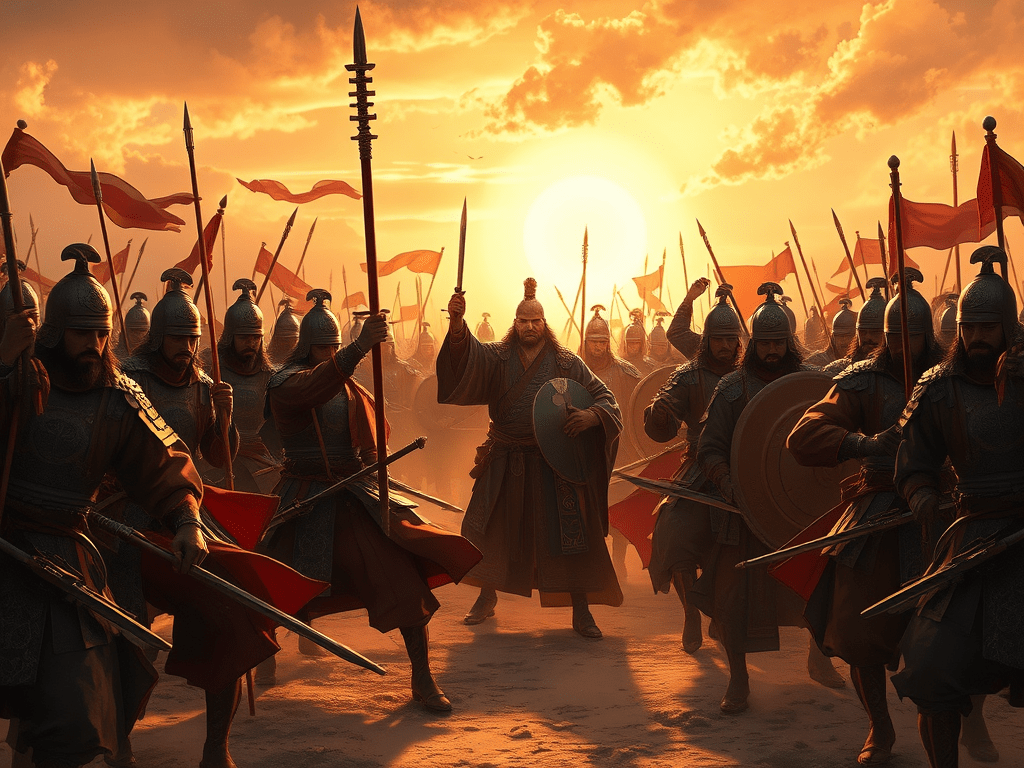
The Art of War is one of if not the most universally known works of strategy. Unfortunately, The Art of War or the Chinese title, Sun Zi Bingfa “Master Sun’s Military Methods”[1] cannot be traced to a particular historical figure or time period in Ancient China.
The Art of War is traditionally placed in the Spring and Autumn period, around 722-481 BCE.[2] However, historians debate the accuracy of the traditional dating and whether Sun Tzu actually wrote the work or was given credit for the writing by later strategists. Using Ralph Sawyer’s translation of The Art of War as well as Toshi Yoshihara’s chapter on Sun Tzu in The New Makers of Modern Strategy, we’ll explore both the dating and authorship of the work. The best way to break down the debate is to put the arguments into one of two camps: the traditionalists and the skeptics.
The traditionalist view holds that Sun Tzu was a historical figure and that he served as a military strategist and possibly even a general under King Helu of the state of Wu.[3] According to this perspective, Sun Tzu fled his native region and sought refuge in Wu, where his strategic talents gained him the attention of the king. A famous legend, which traditionalists often reference, describes how Sun Tzu demonstrated his tactical acumen by training King Helu’s concubines as soldiers, even going as far as executing two of them to enforce discipline. This dramatic event purportedly impressed King Helu, leading him to appoint Sun Tzu as the leader of his armies.[4]
However, traditionalists have been criticized for their reliance on this story, as some scholars argue that the tale of the concubines may be more symbolic than factual. Critics, including Ralph Sawyer, point out that traditionalists might be motivated by a desire to attribute the teachings in The Art of War to a well-known figure rather than an obscure or composite author. By aligning Sun Tzu with a famous military leader, traditionalists believe they can legitimize his strategic doctrines as stemming from practical experience rather than theoretical musings.[5]
In contrast, skeptics doubt the existence of a singular historical Sun Tzu, proposing that The Art of War was written much later during the Warring States period (403–221 BCE)[6] and possibly by multiple authors. Toshi Yoshihara, in The New Makers of Modern Strategy, presents several arguments supporting this perspective, pointing to textual elements that align more closely with the political and military dynamics of the Warring States era rather than the earlier Spring and Autumn period. For instance, the text’s references to large armies numbering in the hundreds of thousands suggest a context more fitting for the Warring States period, when warfare reached an unprecedented scale. During this time, warfare shifted from an aristocratic endeavor to a more professional and meritocratic pursuit, a transition not yet underway in the Spring and Autumn period.[7]
Doubts first arose during the Song Dynasty in the tenth century, when scholars questioned the plausibility of attributing such a sophisticated work to a single individual from an earlier period. Skeptics also highlight the absence of Sun Tzu’s name in key historical records from the Spring and Autumn period, such as the Tso Chuan, which documents significant events of that era.[8] However, it is important to note that the absence of Sun Tzu’s name from a single source does not constitute proof of Sun Tzu’s fabrication. Furthermore, Yoshihara suggests that associating Sun Tzu with an earlier period might have been a deliberate tactic by later authors to lend legitimacy to the text by invoking a venerable, almost mythological figure. By situating Sun Tzu in a past era, the authors could confer an aura of ancient wisdom upon the strategies, thus bolstering the text’s authority.[9]
Sawyer offers a balanced view that attempts to reconcile the traditionalist and skeptical positions. According to Sawyer, Sun Tzu was likely a real person who composed the foundational ideas of The Art of War. However, this core text may have been expanded and refined by his descendants or disciples, who adapted Sun Tzu’s principles to reflect the evolving nature of warfare throughout the Warring States period. This theory explains why the work includes descriptions of military practices and technologies that emerged after Sun Tzu’s supposed lifetime.[10]
Sun Tzu’s identity remains an open question and, as illustrated above, historians generally fall into the traditionalist or skeptical camps. More importantly, The Art of War has influenced thousands of years of strategy. That influence, not settling a debate of Sun Tzu’s history, is the focus of this project and what we turn to next.
[1] Toshi Yoshihara, “Sun Zi and the Search for a Timeless Logic of Strategy,” in The New Makers of Modern Strategy: From the Ancient World to the Digital Age, ed. Hal Brands (Princeton: Princeton University Press, 2023), 68
[2] Ralph D. Sawyer, trans., The Art of War (New York: Basic Books, 1994), 27
[3] Sawyer, The Art of War, 79
[4] Yoshihara p. 68
[5] Sawyer, The Art of War, 156
[6] Sawyer, The Art of War, 27
[7] Yoshihara p. 69-70
[8] Sawyer, The Art of War, 152
[9] Yoshihara p. 70-71
[10] Sawyer, The Art of War, 161-162
 Strategy in Brief
Leave a comment